Part 107 test changes on October 26, 2026
Beginning October 26, 2026, the FAA's Part 107 knowledge test (UAG) includes image-based questions that are not in the printed testing supplement, using up-to-date images from the latest sectional charts. The printed supplement remains available at test centers until the FAA sets and announces a removal date.
What the FAA announced for October 26, 2026
The change comes from the FAA's Airman Testing Community Advisory (ATCA), August 2026 edition. On page 6 it says:
"Beginning October 26, 2026*, the Instrument Rating Airplane (IRA) and Unmanned Aircraft General-Small (UAG) tests will include image-based questions not found in the test supplements (see examples below). This update enhances the tests by incorporating clearer, up-to-date images from the latest Sectional Charts, Instrument Approach Charts, and Low Altitude Enroute Charts."
The asterisk points to a note: "Corrected date from the previous edition of this advisory." If you read an older advisory or an older article with a different date, October 26, 2026 is the date the FAA corrected it to.
The advisory names two sources for the images: VFR charts and IFR low altitude charts. For the remote pilot test, the examples it prints are sectional chart excerpts, which are VFR charts.
This is part of a larger FAA and PSI effort the advisory calls the Graphics Conversion Project. Page 5 explains the aim: "embedding images directly in test questions, eliminating the need for printed test supplements." The same page already lists Unmanned Aircraft among the exams that feature questions with embedded images. The October 26 change adds questions whose images are not in the supplement at all.
What an image-based question looks like
The advisory prints two UAG sample questions. Both follow the same layout:
- The stem opens with "Refer to the image below to answer the question."
- A sectional chart excerpt appears in the question.
- Under the image is a caption naming the chart and its edition dates, for example "Sectional: Washington, dated 12 JUN 2025 to 7 AUG 2025".
- The question follows, with three answer choices, A through C.
One sample asks what type of airspace is associated with a named airport and whether ATC authorization is required to fly a small UA there. The other asks which frequency to use as the Common Traffic Advisory Frequency (CTAF) when an airport's control tower is not in operation. Both are chart-reading tasks: you find the airport on the excerpt, read its symbols and data block, and apply a rule.
The advisory also says the images in live questions will not be shown in advance: "the specific images used in active test questions cannot be previewed, as doing so would compromise the exam's integrity." So you cannot memorize the test's chart excerpts. You need to be able to read any current sectional.
Is the testing supplement going away?
Not yet. Page 5 of the advisory says: "The date for removing testing supplements from test centers has not yet been set. However, the public will receive ample notice before this change takes effect. Until the removal, candidates will continue to have access to the testing supplement for their exam."
The FAA Airman Knowledge Testing Matrix revised September 25, 2026 still lists FAA-CT-8080-2H, the Airman Knowledge Testing Supplement for Sport Pilot, Recreational Pilot, Remote Pilot, and Private Pilot, as the supplement for the UAG test. The PSI bulletin says the test center supplies "The required supplement book".
In practice this means you should expect both kinds of question for now: older questions that refer you to a figure in the supplement, and new questions with the chart image embedded on screen.
Why the chart edition dates in the caption matter
The FAA says the new images come from the latest charts. Sectional charts are reissued on a cycle; the Aeronautical Chart Users' Guide says "These charts are updated every 56 days." According to the FAA's VFR chart page, the sectional edition in effect on October 26, 2026 is the September 3, 2026 edition, and the next edition takes effect October 29, 2026.
Each caption tells you which edition the excerpt came from. Airspace, frequencies and obstacles can change between editions, so answer from what the image shows, not from what you remember about that airport.
Measuring tools and on-screen aids
The advisory says some questions may need measuring tools and that "applicants will have the tools they need to respond accurately." It also says "At this time, we cannot provide details about the design or operation of on-screen tools" and that any significant new electronic tools will be announced in the advisory well in advance.
What is known today comes from the PSI bulletin: PSI's testing software has a built-in four-function calculator, and you may bring your own scales, straightedges, protractors, plotters, navigation computers and a standard nonelectronic handheld magnifying glass. Check the current bulletin before test day.
How to prepare for image-based chart questions
- Practice on current sectionals. The FAA publishes digital versions of its sectional charts on its VFR charts page. Reading real excerpts at screen size is closer to the new format than reading a printed booklet.
- Learn the legend without looking it up. Know the boundary symbols for Class B, C, D and E surface areas, the airport data block, obstacle numbers and the CTAF symbol. The Chart Users' Guide is the FAA's explanation of each symbol.
- Tie each symbol to a rule. The FAA samples combine reading with a rule, such as whether ATC authorization is needed under 14 CFR 107.41. Practice both steps together.
- Read the caption. It tells you the chart name and edition. Treat it as part of the question.
- Keep studying the supplement figures. The supplement is still in use until the FAA announces otherwise.
- Try PSI's free sample test. The advisory encourages candidates to visit the PSI site regularly for sample questions in the new format. The PSI bulletin says the sample test is under the "Exam Resources" link at https://faa.psiexams.com/.
What stays the same
The image questions change how some questions are presented. The advisory does not change the test format in the PSI bulletin (effective September 29, 2025): 60 scored questions plus 5 unscored validation questions, 120 minutes, and a passing score of 70% correct. The topic weights are Regulations 48%, Airspace Classification and Operating Requirements 20%, Weather 5%, Loading and Performance 2%, and Operations 25%.
Fly Part 107 is a free practice site for the UAG knowledge test. It has 520 questions with an explanation for every answer, including 120 chart questions built on ten current FAA sectionals (October 29, 2026 edition) with zoom, plus the Chart Trainer, the Read the Question trainer and a cited cheat sheet. Every chart question carries a caption with the chart name and edition dates, in the same style as the FAA samples. A one-time $49 payment gives lifetime access to full 60-question practice tests with 5 unscored items.
Try these practice questions
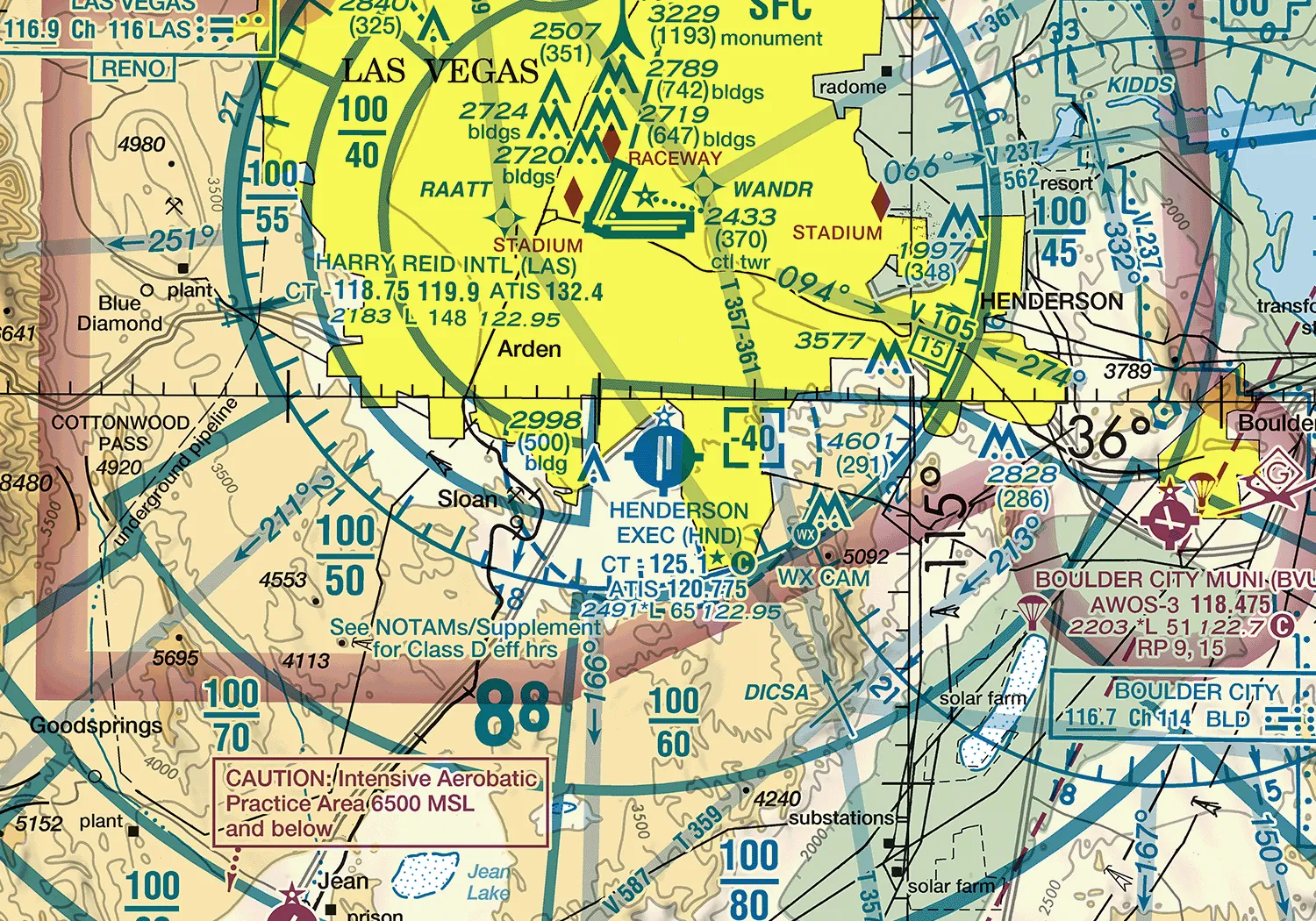
If the control tower at HENDERSON EXEC (HND) is not in operation, which frequency should be used as the Common Traffic Advisory Frequency (CTAF) to monitor airport traffic?
Refer to the image below to answer the question.
- 120.775
- 125.1
- 122.95
Show the answer
Answer: B. In the airport data block, the CTAF is the frequency followed by the C symbol in a circle. The other frequencies near the airport name are for other services such as UNICOM, ATIS or an automated weather station.
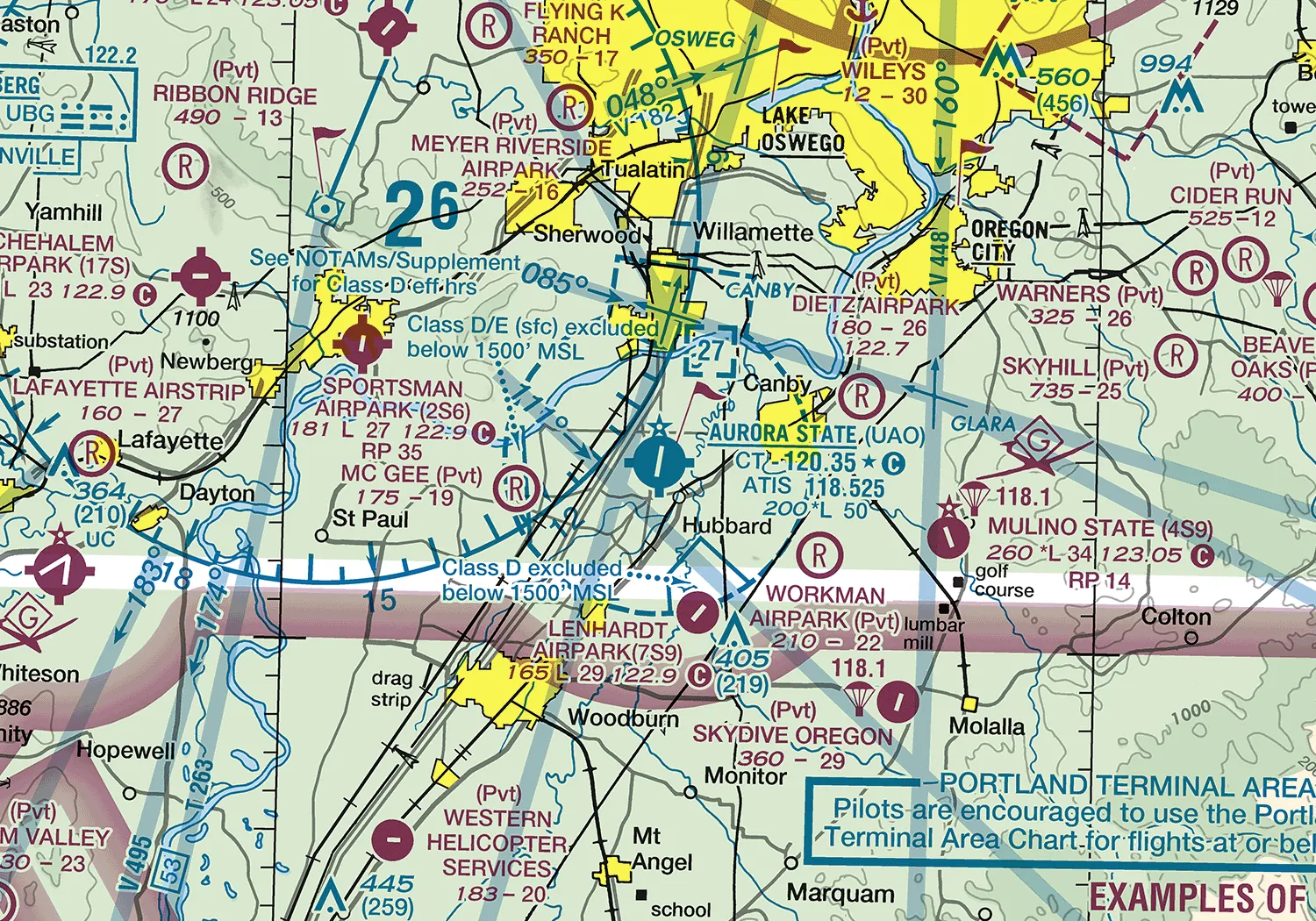
What type of airspace is at the surface at AURORA STATE (UAO) while the control tower is in operation, and is ATC authorization required to operate a small UA there?
Refer to the image below to answer the question.
- Class D, and ATC authorization is required.
- Class G, and ATC authorization is not required.
- Class E surface area designated for the airport, and ATC authorization is required.
Show the answer
Answer: A. The chart shows the airport surrounded by a dashed blue line, which depicts Class D. Under 14 CFR 107.41, operating in Class B, C or D airspace, or within the surface area of Class E designated for an airport, needs prior ATC authorization (for example through LAANC or FAADroneZone).
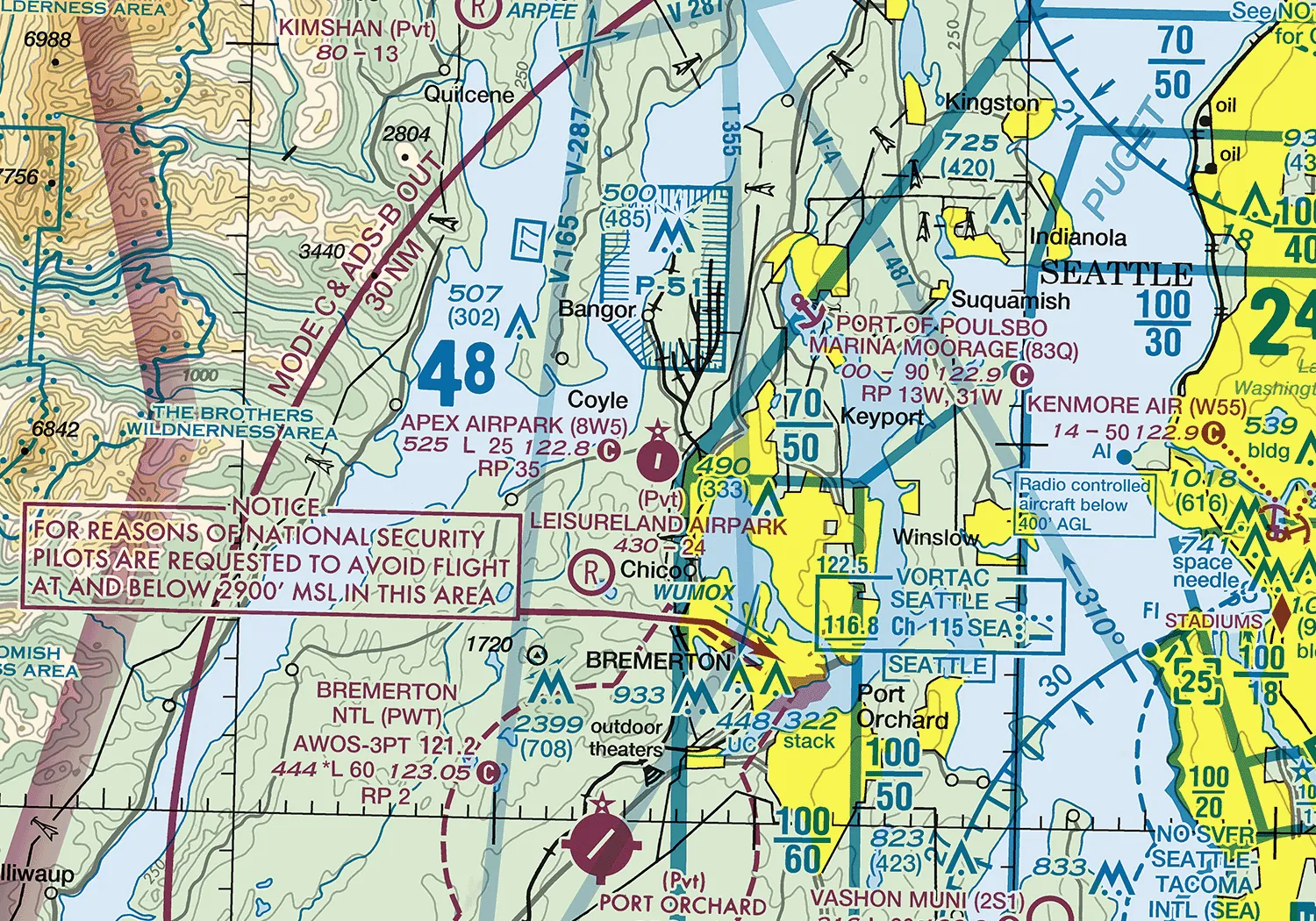
What is the approximate length of the longest runway at APEX AIRPARK (8W5)?
Refer to the image below to answer the question.
- 25 feet
- 250 feet
- 2,500 feet
Show the answer
Answer: C. In the airport data block, the number after "L" (or after the elevation) is the length of the longest runway in hundreds of feet, so 25 means about 2,500 feet.
Every question in the app has an explanation like these. Practice more for free.
Frequently asked questions
When does the Part 107 test change?
The FAA's August 2026 advisory says the UAG test will include image-based questions not found in the test supplements beginning October 26, 2026. The advisory notes that this is a corrected date from its previous edition.
Will I still get the testing supplement at the test center?
Yes, for now. The FAA says the date for removing testing supplements has not been set, the public will get ample notice, and until then candidates keep access to the supplement. The September 25, 2026 testing matrix still lists FAA-CT-8080-2H for UAG.
Can I see the chart images that are used on the real test?
No. The FAA says the specific images used in active test questions cannot be previewed because that would compromise the exam's integrity. Practice reading current sectionals instead.
How many answer choices do the new chart questions have?
Both UAG sample questions in the FAA advisory have three choices, A through C. PSI describes the test as multiple choice where you select the one best answer.
Sources
- FAA Airman Testing Community Advisory, August 2026 Edition
- FAA Airman Knowledge Testing Matrix (revised September 25, 2026)
- PSI, Unmanned Aircraft General - Small (UAG) Applicant Information Bulletin
- FAA Aeronautical Chart Users' Guide (effective July 9, 2026)
- FAA VFR Raster Charts and Dates of Latest Editions
- 14 CFR Part 107, Small Unmanned Aircraft Systems (eCFR)