Part 107 practice test: format and how to prepare
The Part 107 knowledge test (UAG) has 60 scored questions plus 5 unscored ones, a 2-hour limit, and a 70% passing score. A useful practice test copies that format and the official topic weights, with Regulations the largest share at 48%.
The format of the real Part 107 test
| Item | Value | Source |
|---|---|---|
| Scored questions | 60 | PSI bulletin; FAA testing matrix |
| Unscored validation questions | 5, mixed in | PSI bulletin |
| Time allowed | 120 minutes | PSI bulletin; testing matrix (2.0 hours) |
| Passing score | 70% correct | PSI bulletin; testing matrix |
| Question type | Multiple choice, one best answer | PSI bulletin |
| Minimum age to test | 14 | Testing matrix |
| Instructor endorsement | Not required, to test or retest | PSI bulletin; testing matrix |
The PSI bulletin explains the unscored items: "In addition to the 60 questions in the UAG exam, 5 validation questions will be administered to applicants during the examination. These questions will not be scored, and the allotted time for the exam includes sufficient time required to respond to validation questions." You will not know which 5 they are, so answer every question as if it counts.
Topic weights: what the 60 questions cover
The PSI bulletin, effective September 29, 2025, gives the share of items in each content area. The question counts in the last column are simple arithmetic on 60 questions and are approximate.
| Content area | ACS area | Share of items | About how many of 60 |
|---|---|---|---|
| Regulations | UA.I | 48% | 29 |
| Airspace Classification and Operating Requirements | UA.II | 20% | 12 |
| Weather | UA.III | 5% | 3 |
| Loading and Performance | UA.IV | 2% | 1 |
| Operations | UA.V | 25% | 15 |
PSI says these percentages "were determined by the industry-wide job task analysis study completed in 2025." Older topic ranges printed in the ACS predate that study. Regulations alone is nearly half the test, so plan your study time to match.
The knowledge areas the regulation lists
14 CFR 107.73 lists what the initial aeronautical knowledge test covers. A practice test should touch every one of these:
- Regulations on small UAS rating privileges, limitations and flight operation
- Airspace classification, operating requirements and flight restrictions
- Aviation weather sources and effects of weather on small UA performance
- Small UA loading
- Emergency procedures
- Crew resource management
- Radio communication procedures
- Determining the performance of the small UA
- Physiological effects of drugs and alcohol
- Aeronautical decision-making and judgment
- Airport operations
- Maintenance and preflight inspection procedures
- Operation at night
After you pass
Passing the test is one of the eligibility requirements in 14 CFR 107.61, along with being at least 16 years old and able to read, speak, write and understand English. Under § 107.63 your application must include evidence that you passed. A temporary certificate is issued for up to 120 calendar days until a permanent certificate is issued (§ 107.64). From then on, § 107.65 requires that you passed the initial test or completed recurrent training within the previous 24 calendar months to keep acting as remote pilot in command.
If you do not pass: the 14-day retest rule
14 CFR 107.71 says: "An applicant for a knowledge test who fails that test may not reapply for the test for 14 calendar days after failing the test." The PSI bulletin and the FAA testing matrix add that you must bring the failed Airman Knowledge Test Report (AKTR) to the test center before retesting, and that no instructor endorsement is required.
The FAA testing matrix notes that the UAG test report has ACS codes printed on it. Use them to choose what to review during the 14 days.
What to bring, and what the test center provides
Under 14 CFR 107.67(b) your identification must show your photograph, signature, date of birth and permanent mailing address. The FAA's remote pilot page says to get an FAA Tracking Number (FTN) by creating an IACRA profile before you register for the test.
According to the PSI bulletin, the test center supplies the required supplement book, scratch paper and a writing instrument, and PSI's testing software has a built-in four-function calculator. You may bring scales, straightedges, protractors, plotters, navigation computers and a standard nonelectronic handheld magnifying glass. Phones, watches, notebooks and reference material are not allowed in the testing room.
How to practice so the score means something
- Take full-length tests under time. Sixty-five questions in 120 minutes is a little under 2 minutes each. Timed practice shows you whether chart questions slow you down.
- Read every explanation, including for questions you got right. A correct guess teaches nothing unless you check why the other choices are wrong.
- Track results by topic. A total score hides weak areas. With Regulations at 48%, a weak spot there costs the most.
- Read the whole question before the choices. Small details in the stem change the answer: MSL versus AGL, calendar days, a tower that is closed.
- Practice chart reading on current sectionals. From October 26, 2026, the FAA adds questions with images from the latest sectional charts that are not in the testing supplement.
- Aim above 70% in practice. A score just at the line on familiar questions leaves no margin for new ones.
PSI also offers a free sample test under the "Exam Resources" link at https://faa.psiexams.com/. PSI notes its samples "do not represent the full range of content or difficulty levels contained in the actual examination."
Chart questions after October 26, 2026
The FAA's August 2026 advisory says the UAG test will include image-based questions using up-to-date images from the latest sectional charts. Its samples show the chart excerpt in the question, a caption with the chart name and edition dates, and three answer choices. The printed supplement stays available until the FAA announces a removal date, so practice both styles.
Fly Part 107 is a free practice site for the UAG knowledge test. It has 520 questions with an explanation for every answer, including 120 chart questions built on ten current FAA sectionals (October 29, 2026 edition) with zoom, plus the Chart Trainer, the Read the Question trainer and a cited cheat sheet. Practice questions follow the official topic mix and format; they are not real test questions, which the FAA does not publish. A one-time $49 payment gives lifetime access to full 60-question practice tests with 5 unscored items.
Try these practice questions
During a part 107 flight, the small unmanned aircraft strikes a bystander, who briefly loses consciousness and then recovers. What is required?
- The remote PIC must report it within 10 calendar days.
- No report, because the bystander recovered.
- The owner must report it to the FAA within 30 calendar days.
Show the answer
Answer: A. A is correct: 14 CFR 107.9(a) requires the remote PIC to report to the FAA, no later than 10 calendar days after the operation, any operation involving serious injury or any loss of consciousness. B is wrong: 107.9(a) covers any loss of consciousness, even a brief one, so a report is required. C is wrong: 107.9 places the duty on the remote PIC, and the deadline is 10 calendar days, not 30.
Why the other answers miss
- B. 107.9(a) covers any loss of consciousness, even a brief one, so a report is required.
- C. 107.9 places the duty on the remote PIC, and the deadline is 10 calendar days, not 30.
A remote pilot plans a flight at 150 feet AGL inside the surface area of a Class C airport. What does Part 107 require?
- Prior authorization from ATC
- Two-way radio contact with approach control
- An operating Mode C transponder
Show the answer
Answer: A. A is correct: 14 CFR 107.41 requires prior authorization from ATC to operate in Class C airspace. B is wrong: two-way radio contact is what the Chart Users' Guide describes for arriving VFR (manned) aircraft; the Part 107 requirement is prior ATC authorization. C is wrong: 14 CFR 107.52 prohibits operating a small UAS with a transponder on unless otherwise authorized by the Administrator.
Why the other answers miss
- B. Radio contact is the manned VFR arrival procedure, not the Part 107 rule.
- C. Section 107.52 prohibits a transponder on unless authorized.
A remote pilot reviews this report before a survey flight: METAR KXYZ 141753Z 18015G25KT 3SM -RA BKN008 OVC015 18/16 A2992. What is the highest wind speed the report indicates?
- 15 knots, the two-minute average speed
- 25 knots, the peak gust
- 40 knots, the gust added to the average
Show the answer
Answer: B. B is correct: in 18015G25KT, 15 is the average wind speed and the number after G is the gust. The Aviation Weather Handbook states that the coded speed of the gust is the maximum instantaneous wind speed, so the highest speed reported is 25 knots. A is wrong: 15 knots is the average speed, not the highest speed in the report. C is wrong: the gust value is the peak speed itself, not an amount added to the average, so the peak is 25 knots, not 40.
Why the other answers miss
- A. 15 knots is the average speed, which is real but not the highest speed reported.
- C. The G value is the peak speed itself; it is not added to the average speed.
During a Part 107 flight, an in-flight emergency requires immediate action, and the only safe option is to climb briefly above 400 feet AGL. What does Part 107 allow the remote PIC to do?
- Deviate from any rule as far as needed to meet the emergency
- Deviate only from the altitude limit, and only after ATC approves it
- Nothing; the PIC must stay below 400 feet and land immediately
Show the answer
Answer: A. A is correct: § 107.21(a) says that in an in-flight emergency requiring immediate action, the remote PIC may deviate from any rule of Part 107 to the extent necessary to meet that emergency. B is wrong: the permission covers any rule of the part and does not require ATC approval first. C is wrong: § 107.21 exists precisely so the PIC can deviate when an emergency requires it.
Why the other answers miss
- B. § 107.21 covers any rule of Part 107 and requires no ATC approval before acting.
- C. § 107.21 lets the PIC deviate when the emergency requires immediate action.
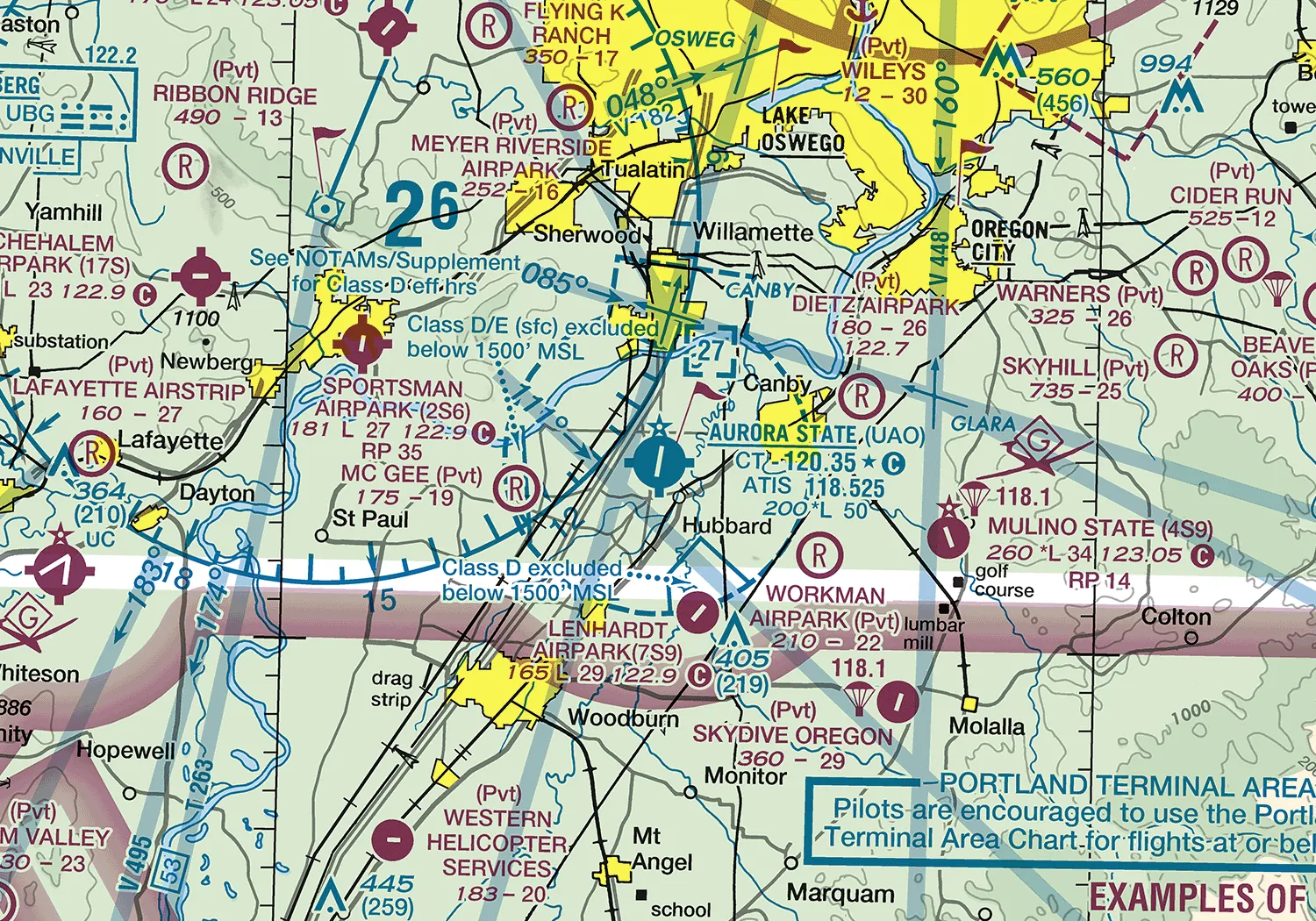
What type of airspace is at the surface at AURORA STATE (UAO) while the control tower is in operation, and is ATC authorization required to operate a small UA there?
Refer to the image below to answer the question.
- Class D, and ATC authorization is required.
- Class G, and ATC authorization is not required.
- Class E surface area designated for the airport, and ATC authorization is required.
Show the answer
Answer: A. The chart shows the airport surrounded by a dashed blue line, which depicts Class D. Under 14 CFR 107.41, operating in Class B, C or D airspace, or within the surface area of Class E designated for an airport, needs prior ATC authorization (for example through LAANC or FAADroneZone).
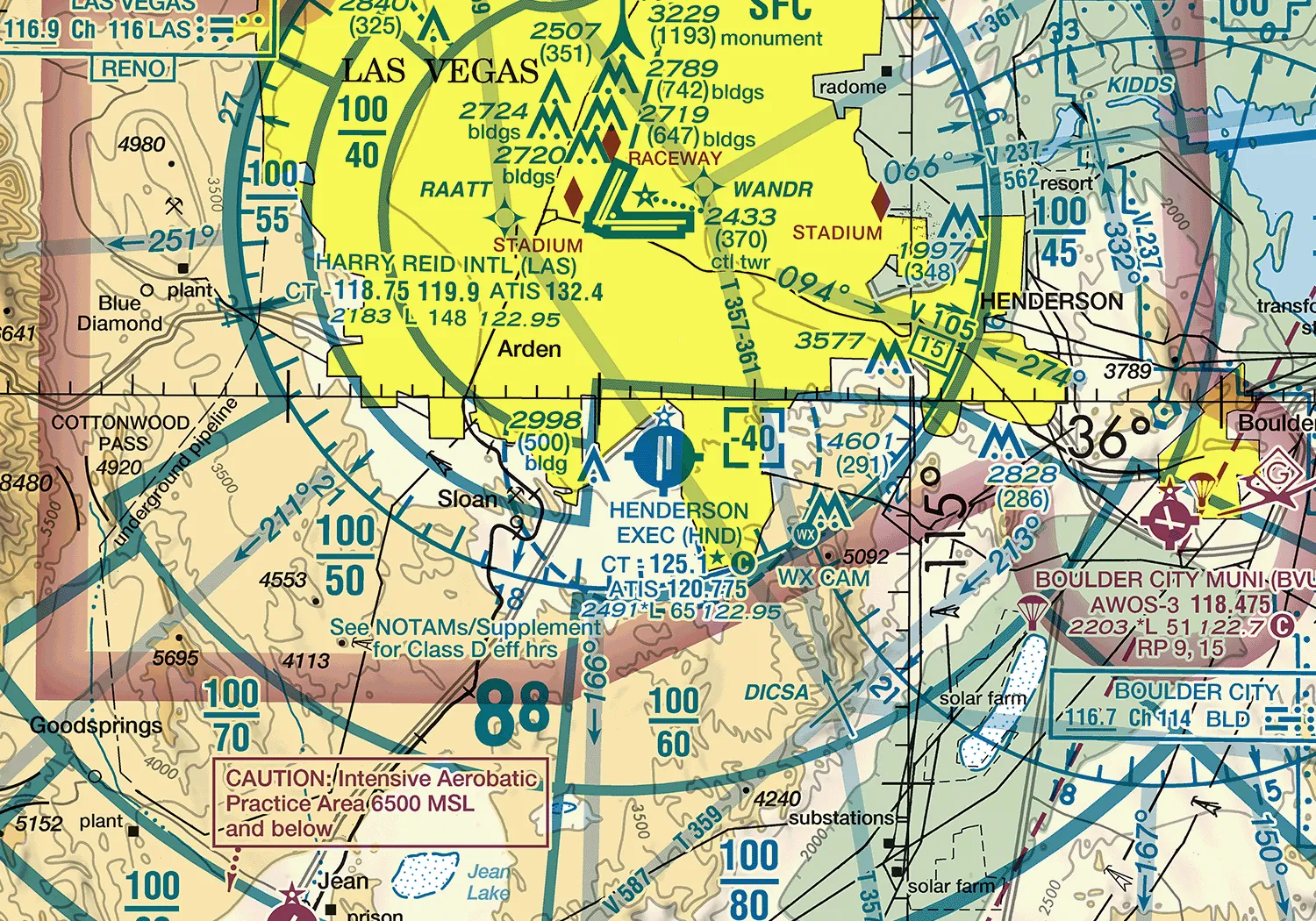
If the control tower at HENDERSON EXEC (HND) is not in operation, which frequency should be used as the Common Traffic Advisory Frequency (CTAF) to monitor airport traffic?
Refer to the image below to answer the question.
- 120.775
- 125.1
- 122.95
Show the answer
Answer: B. In the airport data block, the CTAF is the frequency followed by the C symbol in a circle. The other frequencies near the airport name are for other services such as UNICOM, ATIS or an automated weather station.
Every question in the app has an explanation like these. Practice more for free.
Frequently asked questions
How many questions are on the Part 107 test?
60 scored questions, plus 5 unscored validation questions mixed in, according to the PSI bulletin. You have 120 minutes for all of them.
What score do I need to pass the Part 107 test?
70% correct, per the PSI bulletin and the FAA testing matrix.
How soon can I retake the Part 107 test if I fail?
After 14 calendar days, under 14 CFR 107.71. Bring your failed test report to the center; no instructor endorsement is needed.
How old do I have to be to take the Part 107 test?
The FAA testing matrix lists a minimum age of 14 to take the UAG test. You must be at least 16 to be eligible for the remote pilot certificate itself under 14 CFR 107.61.
Sources
- PSI, Unmanned Aircraft General - Small (UAG) Applicant Information Bulletin
- FAA Airman Knowledge Testing Matrix (revised September 25, 2026)
- 14 CFR Part 107, Small Unmanned Aircraft Systems (eCFR)
- FAA Airman Testing Community Advisory, August 2026 Edition
- FAA, Become a Certificated Remote Pilot